Shopping Cart
No item in your cart!
RM0.00

文章作者: Anonymous
17 March 2026

Kidney disease is becoming an increasingly important health issue in Malaysia, yet many people remain unaware of the risks until the condition has already progressed.
Recent national health data shows that chronic kidney disease (CKD) is becoming more common among Malaysians. The prevalence of CKD increased from 9.07% in 2011 to 15.48% in 2018, according to findings from the National Health and Morbidity Survey. This means that nearly 1 in 6 Malaysian adults may be living with some degree of kidney disease, many of whom may not be aware of their condition.
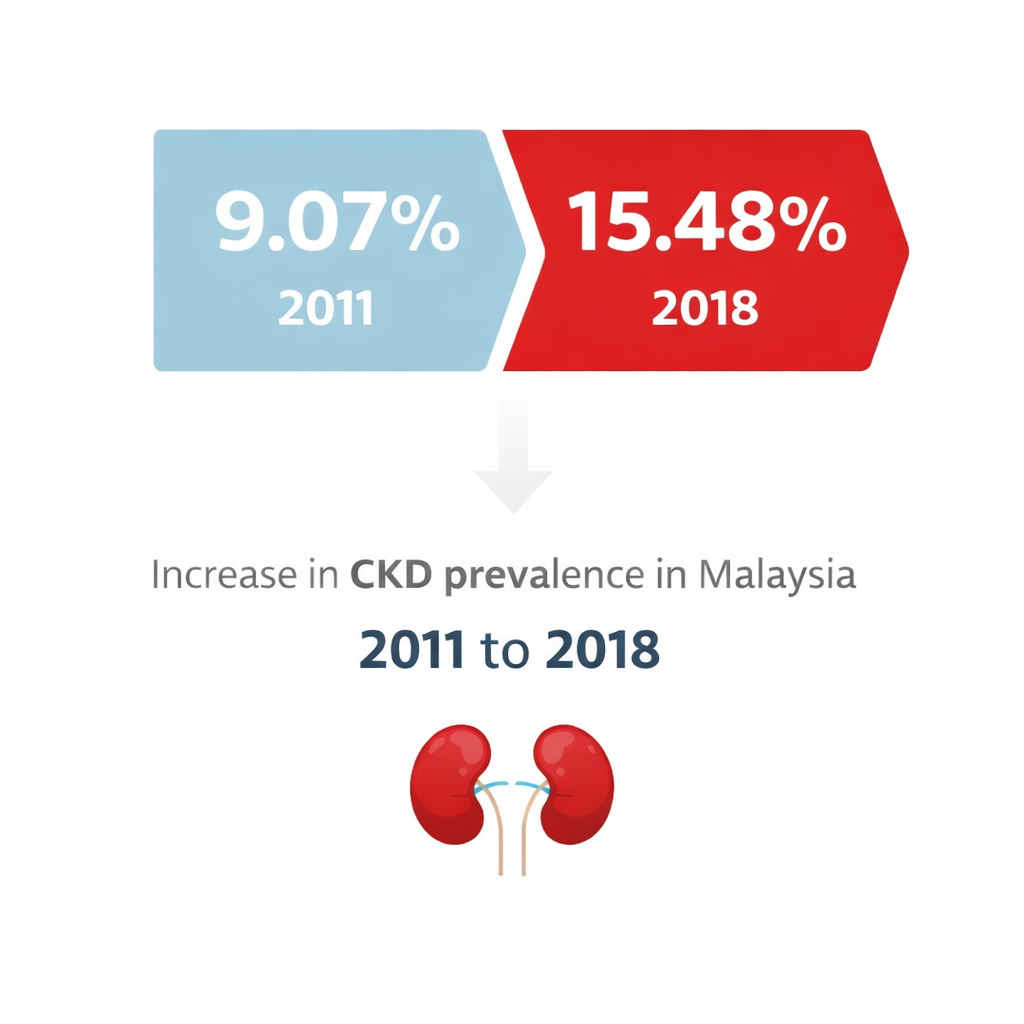
National Health and Morbidity Survey
Several factors are believed to contribute to this rising trend. Malaysia has seen a growing number of people living with diabetes, high blood pressure, obesity, and metabolic conditions, all of which are major risk factors for kidney damage. As the population ages and lifestyle-related health conditions become more common, the number of people at risk of developing CKD also increases.
Another concern is that kidney disease often progresses quietly in its early stages. Many individuals do not experience symptoms until kidney function has already declined significantly. Without routine health screening, CKD may remain undetected until it reaches a more advanced stage.
One of the biggest challenges with kidney disease is that it can develop silently.
In the early stages, many people do not experience noticeable symptoms. As a result, the condition may only be discovered when kidney function has already declined significantly.
This is why chronic kidney disease is sometimes referred to as a “silent condition.”
Without early detection and management, CKD can progress to kidney failure, where patients may require dialysis or kidney transplantation to sustain life.
For this reason, healthcare professionals emphasise the importance of regular health screening — especially for individuals with known risk factors.
Malaysia is not alone in facing this challenge. Across the Asia-Pacific region, kidney disease represents a significant and growing healthcare burden.
However, the situation in Malaysia reflects a particularly concerning trend. Data from national studies indicates that the prevalence of chronic kidney disease among adults increased substantially between 2011 and 2018.
At the same time, the financial burden of kidney failure treatment has also risen.
As the number of patients with kidney disease increases, the cost of treatment has also grown significantly.
Government estimates indicate that national spending on kidney failure care rose from approximately RM572 million in 2010 to RM1.12 billion in 2016. This sharp increase reflects the growing demand for long-term treatment such as dialysis and ongoing medical care for patients with advanced kidney disease.
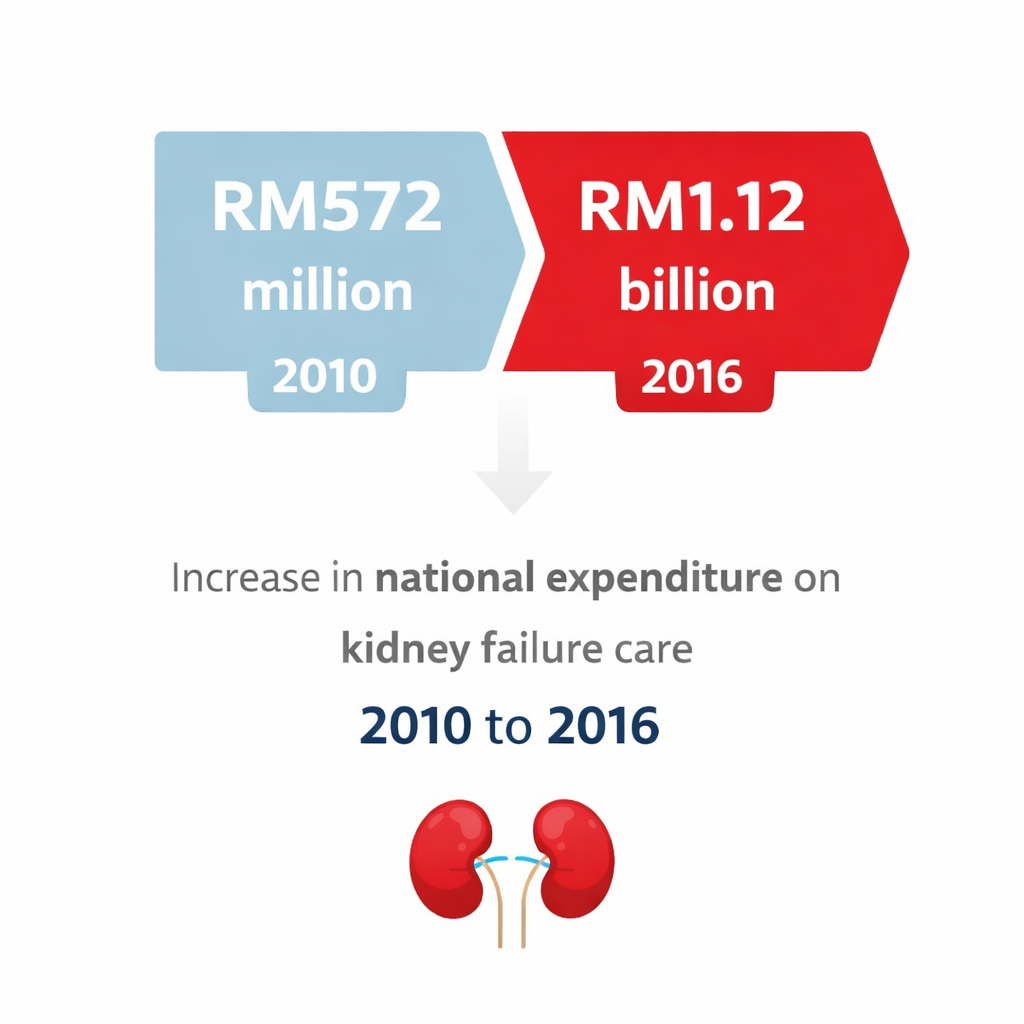
Increase in national expenditure on kidney failure care 2010 to 2016
Kidney failure often requires lifelong treatment, particularly dialysis, which must be performed several times each week. In many cases, patients also require ongoing monitoring, medication, and specialist care, which contributes to the overall healthcare cost.
Dialysis treatment is one of the most resource-intensive aspects of kidney disease management. As more patients progress to end-stage kidney disease, the healthcare system must allocate more resources to support dialysis services, trained medical professionals, and specialised equipment.
Chronic kidney disease is often linked to other long-term health conditions that are common in Malaysia.
The most frequent causes include:
Among these, diabetes remains one of the leading contributors to kidney failure, highlighting the close relationship between metabolic health and kidney function.
This also means that individuals living with diabetes or hypertension should pay particular attention to routine kidney health screening.
Another key issue highlighted in regional research is the unequal access to kidney care across communities.
Factors such as geographic location, healthcare resources, workforce availability, and socioeconomic status can influence whether patients receive timely diagnosis and treatment.
Malaysia’s healthcare system includes both public and private sectors. Public healthcare services provide subsidised treatment for citizens, while private healthcare institutions serve both local and international patients.
Strengthening collaboration across these systems is important to ensure patients can receive appropriate care at the right stage of the disease.
Malaysia has taken several important steps to address kidney disease at a national level.
These initiatives include:
These programmes aim to strengthen prevention strategies, improve early diagnosis, and ensure patients receive more coordinated care.
Although kidney disease can be serious, early detection offers an opportunity to manage the condition more effectively.
When chronic kidney disease is identified early, doctors may be able to:
Regular health screening therefore plays an important role in protecting kidney health.
Kidney disease should not be viewed only as a specialist medical condition. It is a broader public health issue that requires increased awareness, preventive care, and access to timely treatment.
As Malaysia continues to face a rising burden of chronic kidney disease, greater public understanding of kidney health will play an important role in improving long-term outcomes.
Early awareness, regular screening, and proactive health management remain some of the most effective ways individuals can protect their kidney health.
- Wu, I., Park, H. C., Kwek, J. L., Kwan, L., Adiya, S., Jesudason, S., Leong, B. C. M., Pyar, K. P., Pichaiwong, W., Vareesangthip, K., Nugroho, P., Henderson, A. D., Ding, X., Manandhar, D. N., Yang, J., & Yanagita, M. (2026). Disease burden and disparities of care for kidney health in the Asian Pacific region: Summary report from the Diversity and Equity Committee of APSN. Nephrology, 31(3), e70186. https://doi.org/10.1111/nep.70186
- Kidney Health on the Global Stage: A Historic WHA Resolution Signals New Hope for Malaysia. (2025). https://nkf.org.my/wp-content/uploads/2025/06/Kidney-Health-on-the-Global-Stage_-A-Historic-WHA-Resolution-Signals-New-Hope-for-Malaysia-060625.pdf
- Saminathan, T. A., Hooi, L. S., Mohd Yusoff, M. F., Ong, L. M., Bavanandan, S., Rodzlan Hasani, W. S., Tan, E. Z. Z., Wong, I., Rifin, H. M., Robert, T. G., Ismail, H., Wong, N. I., Ahmad, G., Ambak, R., Othman, F., Abd Hamid, H. A., & Aris, T. (2020). Prevalence of chronic kidney disease and its associated factors in Malaysia; findings from a nationwide population-based cross-sectional study. BMC Nephrology, 21(1). https://doi.org/10.1186/s12882-020-01966-8
返回