Shopping Cart
No item in your cart!
RM0.00

Knee joint degeneration refers to the progressive breakdown of the cartilage, bone, and surrounding structures within the knee joint. This commonly lead to pain, stiffness, reduced mobility, and eventual loss of daily function. It is one of the most common reasons adults seek orthopaedic care, particularly among those aged 50 and above.
When the cartilage that cushions the knee joint wears down over time, bone begins to rub against bone, causing inflammation, pain, and structural changes within the joint that worsen progressively if left unmanaged.

Knee joint degeneration often develops gradually over months or years. In many cases, the first sign is intermittent discomfort that progressively becomes more persistent — affecting not just physical activity but also rest and sleep.
Physical signs to look out for:
Knee degeneration can occur as a result of different underlying causes — each affecting the joint in distinct ways and requiring tailored management approaches.
The most common form of knee degeneration — characterised by the gradual wear and breakdown of articular cartilage within the knee joint over time. Primary osteoarthritis is strongly associated with ageing, excess body weight, and cumulative joint loading. It typically affects one or more compartments of the knee — the medial (inner), lateral (outer), or patellofemoral (kneecap) compartment — and progresses at varying rates between individuals.
Develops as a result of previous knee injury — including ligament tears, meniscus injuries, or intra-articular fractures — that alter the mechanical environment of the joint and accelerate cartilage breakdown. Post-traumatic arthritis can develop years or even decades after the original injury, and may affect younger patients who would otherwise not be expected to develop significant knee degeneration.
An autoimmune condition in which the immune system attacks the synovial lining of the knee joint — causing chronic inflammation, cartilage destruction, and joint damage. Unlike osteoarthritis which is primarily mechanical, rheumatoid arthritis is driven by immune-mediated inflammation and often affects multiple joints symmetrically. Patients with rheumatoid arthritis managed by a rheumatologist may be referred for orthopaedic assessment when joint damage has progressed to the point where surgical intervention is appropriate.
A condition in which the blood supply to the bone within or around the knee joint is disrupted — causing bone tissue to die and the joint surface to collapse. Avascular necrosis can progress rapidly and may cause severe knee pain disproportionate to radiological findings in its early stages. When bone collapse is significant, knee replacement is often required to restore function.
Accurate diagnosis is essential to determine the type and extent of knee degeneration, identify which compartments are affected, and plan the most appropriate treatment pathway. At Sunway Medical Centre Penang, knee assessment follows a structured process combining clinical examination with diagnostic imaging.
The initial assessment involves a detailed history of symptoms — onset, location, severity, aggravating and relieving factors — followed by a thorough physical examination of the knee. This includes assessment of joint alignment, range of motion, ligament stability, meniscal integrity, and overall lower limb alignment. Functional assessment — including gait observation and daily activity impact — is also an important part of the clinical evaluation.
The combination of clinical findings and imaging results determines the most appropriate treatment pathway — from conservative management through to partial or total knee replacement.
Treatment for knee joint degeneration is planned around the severity of the condition, the degree of functional impairment, the patient's age and activity level, and individual health factors. Not all knee degeneration requires surgery — and the goal of treatment is always to achieve the best possible outcome with the least invasive approach appropriate for the individual patient.
For mild to moderate knee degeneration, conservative management forms the first line of treatment. This may include structured physiotherapy and exercise programmes to strengthen the muscles supporting the knee, pain management through anti-inflammatory medication or topical agents, activity modification and weight management to reduce joint loading, and the use of knee bracing or orthotics to offload affected compartments. Many patients with early-stage knee osteoarthritis achieve meaningful improvement in pain and function through a well-structured conservative programme.
When conservative management provides insufficient relief, joint injections may be recommended as a next step. Corticosteroid injections reduce intra-articular inflammation and provide temporary pain relief — typically lasting weeks to months. Hyaluronic acid injections supplement the natural joint fluid and may improve lubrication and cushioning within the joint. Injections are most effective in mild to moderate degeneration and are generally not appropriate as a long-term solution in severe knee OA.
Where knee degeneration is confined to one compartment of the joint, partial knee replacement — also known as unicompartmental knee arthroplasty — replaces only the damaged compartment while preserving the healthy portions of the knee. Partial replacement results in a more natural joint feel, faster recovery, and less bone removal compared to total knee replacement, but requires careful patient selection based on clinical and imaging findings.
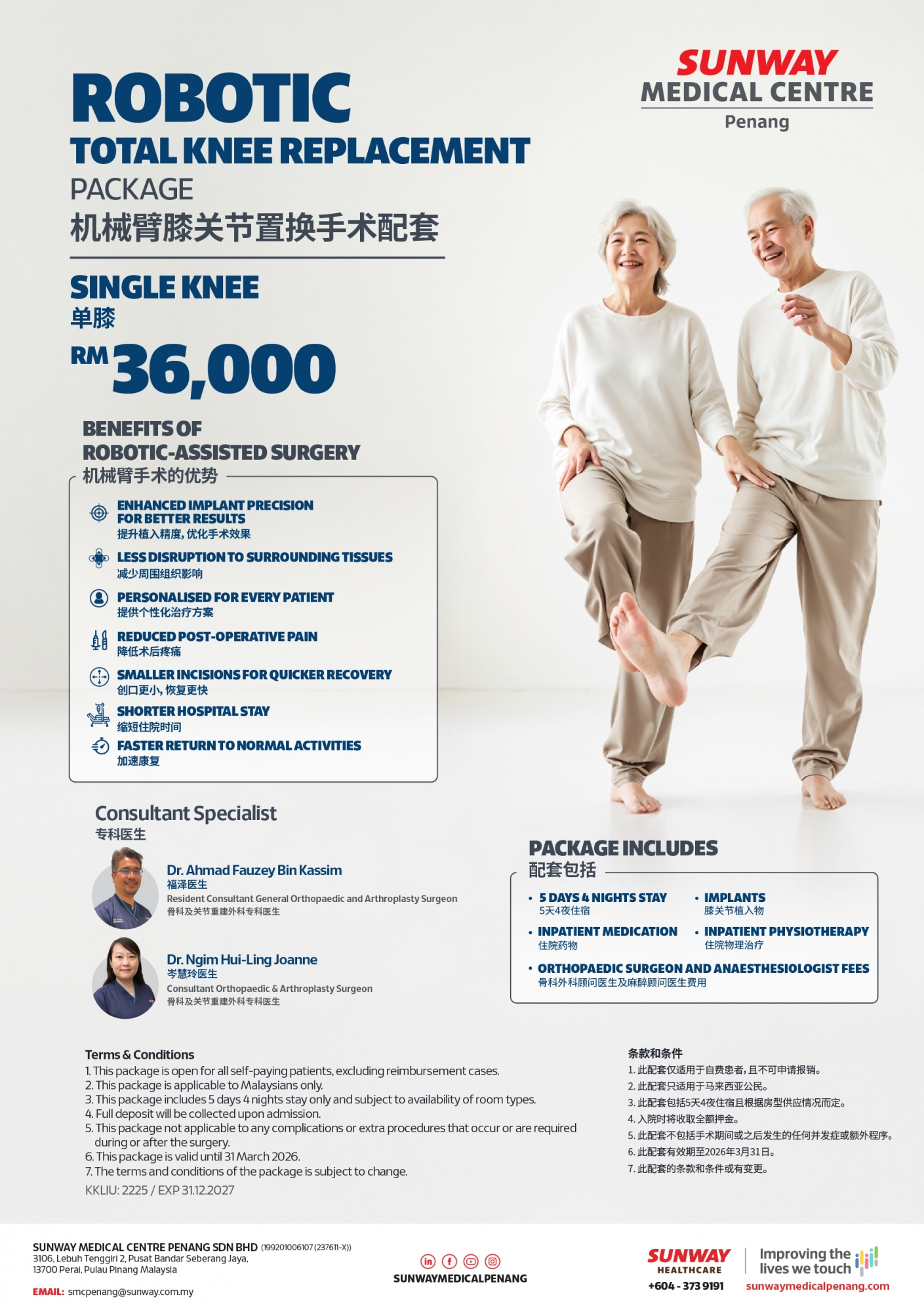
For patients with advanced knee degeneration affecting multiple compartments — where pain, stiffness, and functional loss can no longer be adequately managed conservatively — total knee replacement is the most effective surgical pathway. The procedure involves resurfacing all three compartments of the knee joint with precision-fitted implants, restoring alignment, relieving pain, and recovering the movement and stability needed for daily function. At Sunway Medical Centre Penang, selected knee replacement procedures are performed using MAKO robotic-assisted surgery technology for more precise implant positioning and more predictable outcomes.
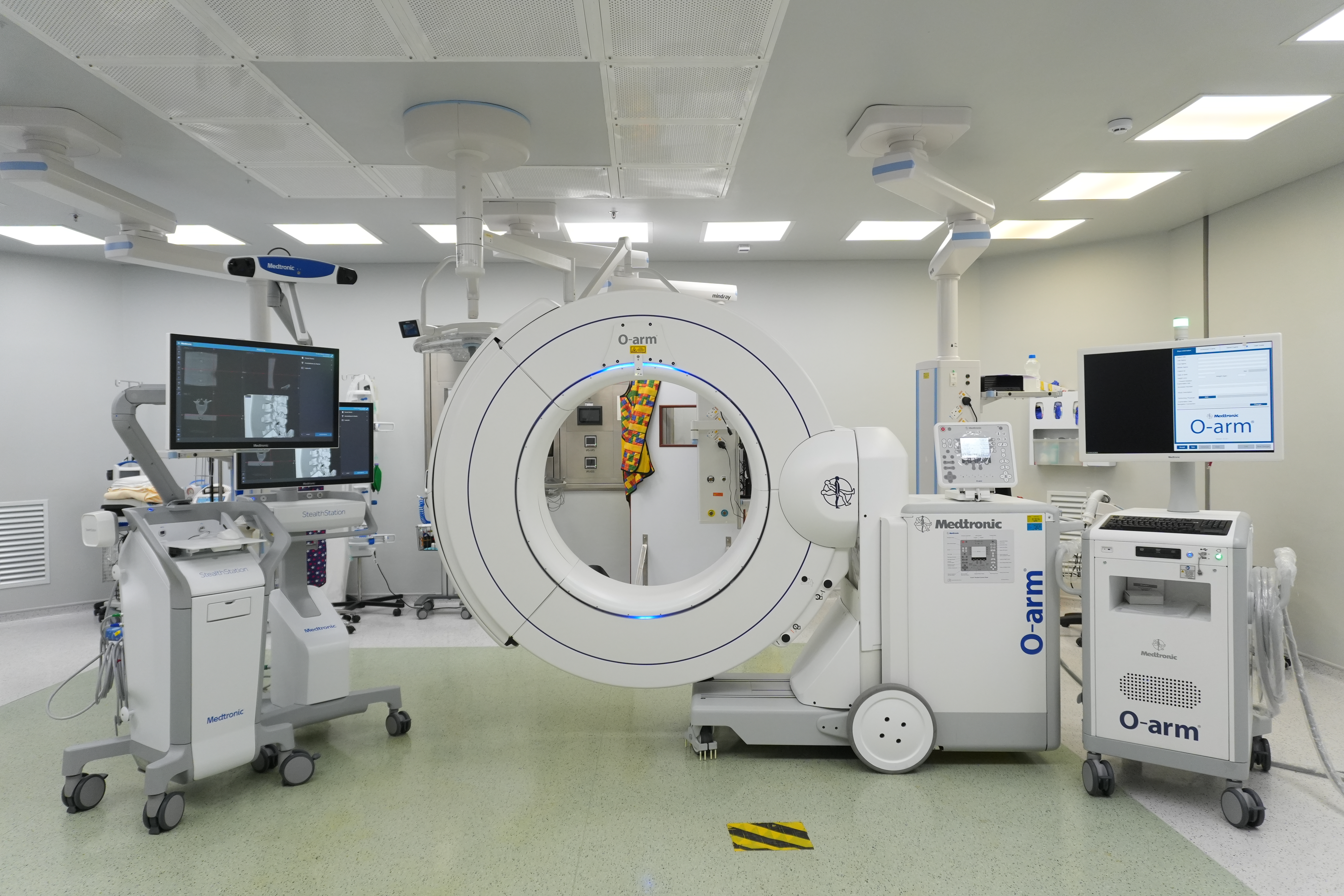
Precision in knee replacement surgery directly affects long-term outcomes — including implant longevity, joint feel, and patient satisfaction. At Sunway Medical Centre Penang, selected knee replacement procedures are supported by the MAKO Robotic System — one of the most advanced joint replacement technologies currently available.
Before surgery, a CT scan is used to create a personalised 3D model of the patient's knee — allowing the surgeon to plan the procedure in precise detail before a single incision is made. During surgery, the MAKO system provides real-time guidance that helps protect surrounding bone and soft tissue while keeping implant placement within the precisely planned boundaries.
This results in more consistent implant positioning, reduced soft tissue disruption, and more predictable post-operative joint function — contributing to better long-term outcomes and higher patient satisfaction compared to conventional manual techniques.
Benefits of MAKO robotic-assisted knee replacement include:
Location:
Level 3 - 313
Contact:
04-373 9191 (Ext. 5881)
Specialty
: Arthroplasty, Orthopaedic Surgery, Robotic Surgery
Qualifications
: MB BCh BAO (TCD, Ireland), MMed Orthopaedic (USM), Fellowship in Joint Reconstruction (MOH)
Languages
: English, Bahasa Malaysia
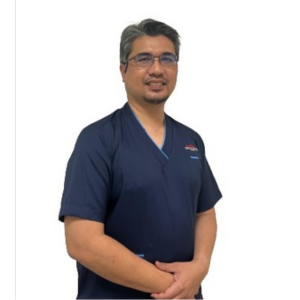
Dr. Ahmad Fauzey Bin Kassim is a resident consultant orthopaedic and arthroplasty surgeon at Sunway Medical Centre Penang, with specialist expertise in joint replacement surgery — including total and partial knee replacement, hip replacement, and MAKO robotic-assisted arthroplasty. His clinical focus includes both conservative management of knee joint degeneration and surgical intervention when replacement is the most appropriate pathway.
For patients with knee joint degeneration — whether in the early stages exploring non-surgical options, or considering knee replacement surgery — Dr. Ahmad Fauzey provides a thorough assessment and a clearly explained treatment plan tailored to each patient's specific condition, lifestyle, and recovery goals.
Modern knee replacement implants are designed to last 15 to 20 years or more in most patients — with studies showing that over 90% of total knee replacements are still functioning well at 15 years. Implant longevity is influenced by factors including patient age, activity level, body weight, and the precision of implant positioning during surgery. At Sunway Medical Centre Penang, MAKO robotic-assisted surgery supports more consistent implant placement — a key factor in long-term implant performance.
There is no strict age limit for knee replacement. The decision is based on the severity of degeneration, the degree of functional impairment, and the patient's overall health — not age alone. Younger patients may be advised to exhaust conservative options first given the possibility of requiring revision surgery later in life. Older patients in good health can undergo knee replacement safely and typically experience significant improvement in quality of life and independence.
In many cases, yes — provided that conservative management is still providing meaningful relief and daily function is not severely compromised. However, delaying surgery when degeneration is advanced can allow the surrounding muscles and soft tissues to weaken further, which may affect rehabilitation and recovery after eventual surgery. Your orthopaedic surgeon will advise on the optimal timing based on your clinical findings and functional status.
Partial knee replacement replaces only the damaged compartment of the knee while preserving the healthy cartilage and bone in the remaining compartments. It results in a more natural joint feel and faster recovery but requires careful patient selection — degeneration must be confined to one compartment and ligaments must be intact. Total knee replacement resurfaces all three compartments and is indicated for more widespread degeneration. Your surgeon will assess which approach is most appropriate based on imaging and clinical findings.
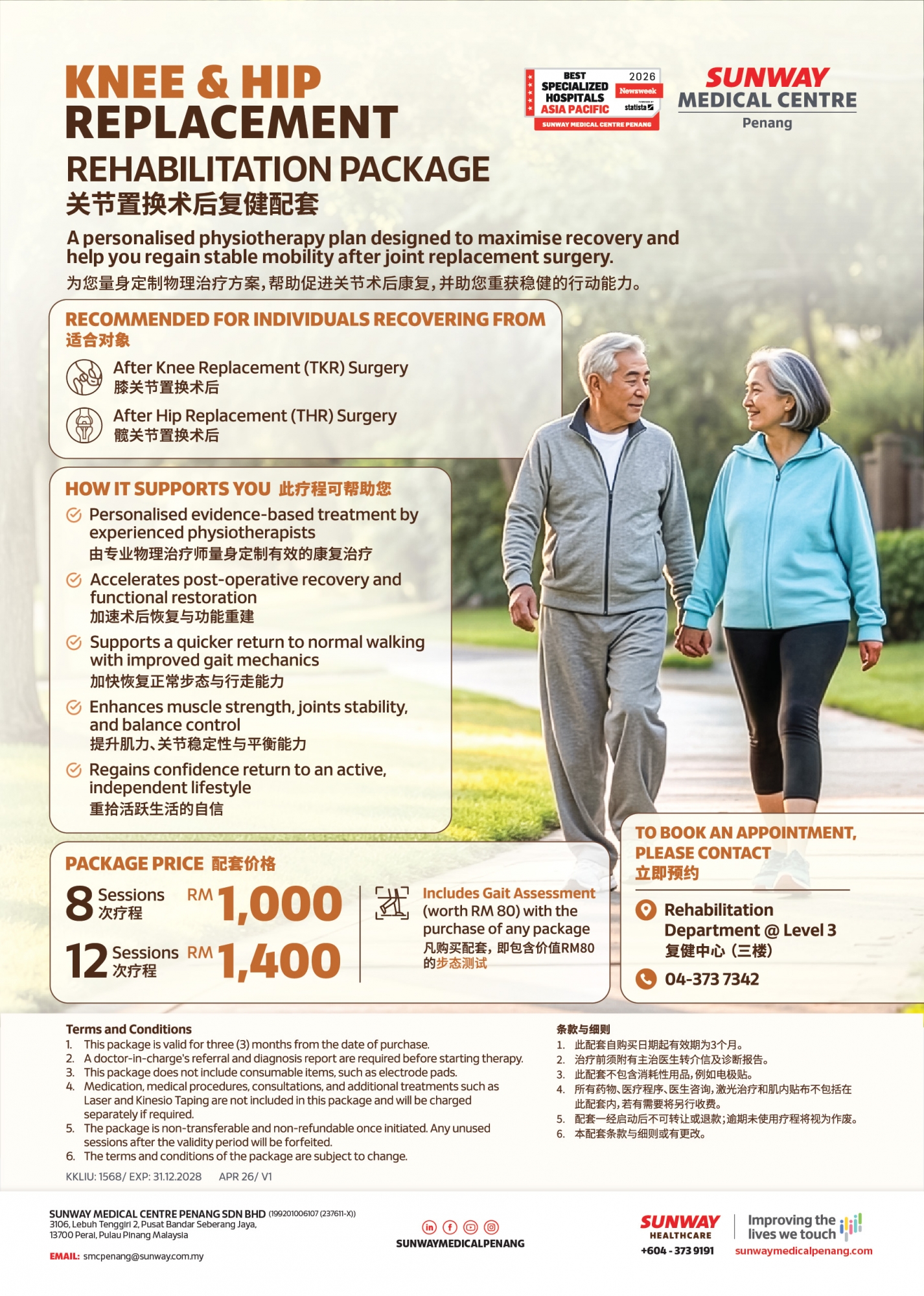
Most patients begin supervised physiotherapy and walking with assistance within 24 hours of surgery. Light daily activities are generally resumed within 4 to 6 weeks, with progressive return to fuller function over 3 to 6 months depending on the procedure and individual health. At Sunway Medical Centre Penang, post-surgical rehabilitation is supported on-site — including the HUR Pneumatic Rehabilitation System and specialist physiotherapy — ensuring a structured and monitored recovery from the day after surgery.
Early assessment does not mean surgery — it means understanding where your knee stands and having a clear plan. Speak with our knee replacement specialist at Sunway Medical Centre Penang to understand your condition and the options available to you.
Book a Consultation with Dr. Ahmad Fauzey Bin Kassim
Read More: Bones and Joints Care | Joint Replacement Surgery | Orthopaedic Specialists | Advanced Orthopaedic and Rehabilitation Care


























Make Appointment Now
Looking for Specialist Care? Schedule a Consultation Today.